

GRDCA President highlighted the stability of the framework and transparency as prerequisites for attracting the customers that will support investments in data centers, while Association members called for power allocation based on readiness criteria.
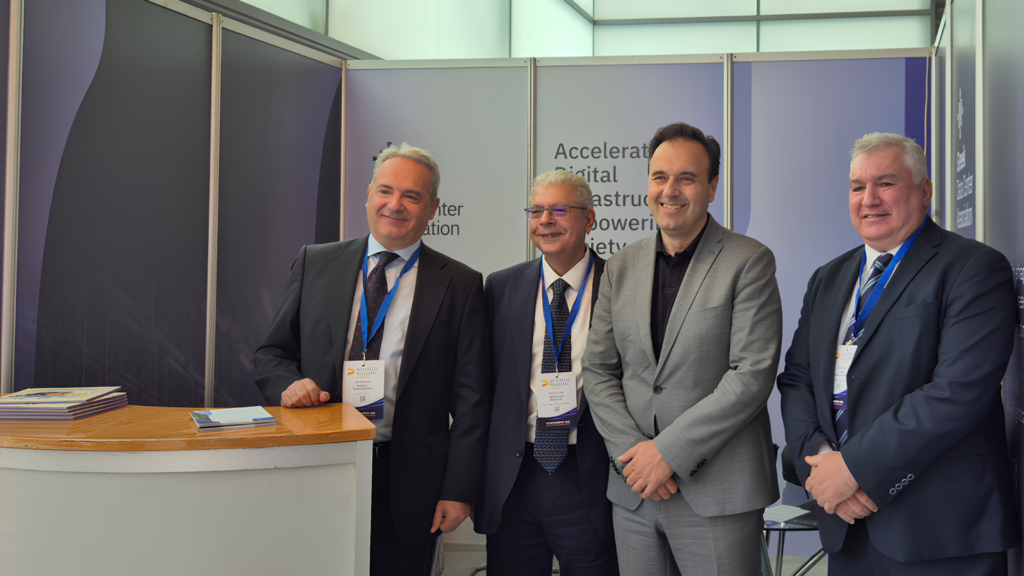
Athens, 8.10.2026: The Greek Data Center Association (GRDCA), the organization representing data center operators, service providers and stakeholders involved in the sector, participated in the Advanced Telecoms Summit 2026, held on 29 September at the Hellenic Cosmos Cultural Center in Athens. The Association was present in the exhibition area and in three sessions of the programme, bringing together the data center sector and the telecommunications market.
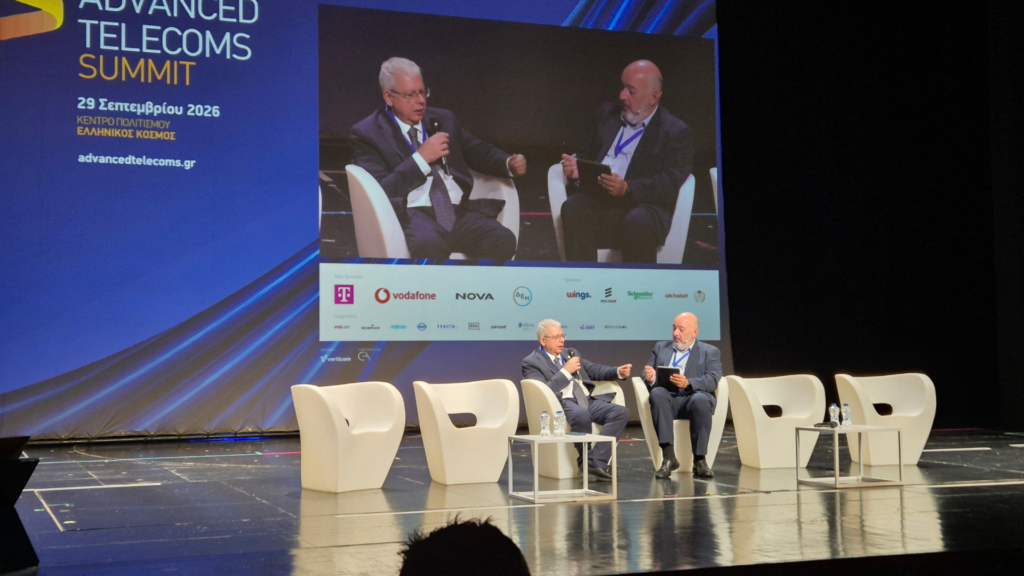
In Session I, “Fiber Optic Cable Systems: The Key to Greece’s Development as a Digital Hub”, Alexandros Bechrakis, Chairman of GRDCA and Managing Director of Digital Realty Greece, noted during a fireside chat with CNN Greece journalist Dimitris Mallas that the Greek market cannot absorb on its own the capacities currently being discussed as being under construction, and that demand will have to come from abroad. Data center investments follow customers, and not the other way around, while international investors consistently choose destinations where decisions are implemented more quickly. For this reason, as he pointed out, attracting major investments depends on a predictable and stable framework, transparency in procedures and open competition.
On connectivity, Mr. Bechrakis noted that high-speed connectivity in Greece remains an order of magnitude more expensive than in Europe, despite signs of efforts to reduce costs, and that a submarine cable system requires the same or even more time to implement than a data center. Regarding artificial intelligence, he stressed that Athens needs infrastructure closer to users in order to support low-latency applications.
Alexandros Bechrakis said: “The growth of the Greek data center market is real and will continue, but it will not be determined by intentions and applications. It will be determined by how quickly the country can turn its advantages into projects that have customers. The issue is not to say that we will become a digital hub, but to actually become one. An investor who can choose among dozens of countries will choose where the rules are clear and decisions are made in a timely manner. We are optimistic because Greece had fallen behind and the need for infrastructure is significant. Now, all of us — the sector, institutions and society — need to contribute both our effort and our thinking in order to move forward even faster.”
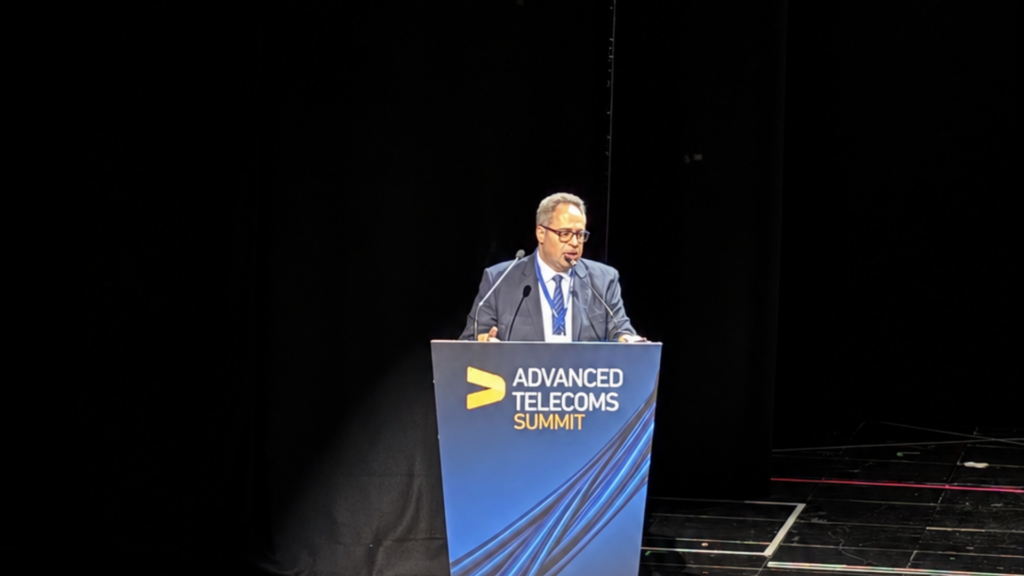
Session II, “Data Centers: The Current Situation and the Next Plans”, began with a keynote by Thanassis Tsikogias, Senior Data Center Solutions Architect at Schneider Electric. He highlighted how infrastructure design has evolved in the age of AI: power requirements per rack have increased from 2 to 3 kW 15 to 18 years ago to more than 100 kW today, while customers are asking for implementation within 12 to 18 months and the ability to expand quickly. The answer, as he explained, is modular design with prefabricated units and the use of digital simulation tools from the design stage.
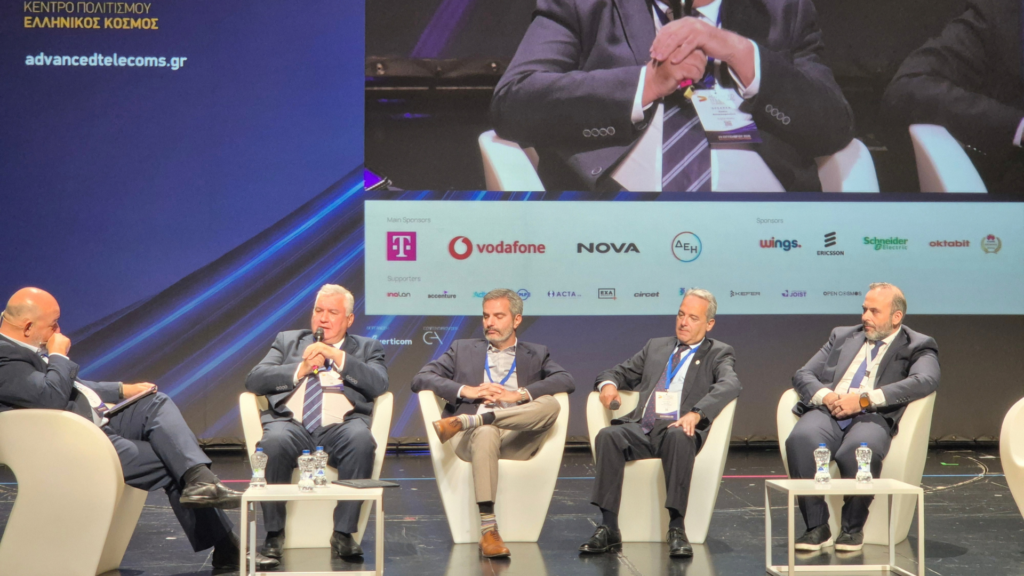
In the panel of the same session, moderated by Dimitris Mallas, representatives of three GRDCA member companies participated and presented the development of major Data Center projects in Greece, from the initial announcement to their implementation.
Sakis Amaxopoulos, GRDCA Board Coordinator and Senior Business Development Manager at Digital Realty Greece, said that Athens 4 is ready and scheduled to be inaugurated next month, while Athens 5 is currently in the design phase.
Nikolaos Konstantinidis, Vice Chairman of GRDCA and Country Director Greece at Data4 Greece, noted that the first phase of the Paiania campus is already operational, while the second phase is expected in 2027.
Antonis Oikonomou, Enterprise Commercial Lead for Greece, Cyprus, Malta and the Adriatic at Microsoft, estimated that the cloud region facilities will be ready in approximately one year, with the first customers expected to be hosted in 2028.
As regards the obstacles, the common point was energy. Mr. Amaxopoulos argued that construction, as a technical issue, has been resolved, and that delays arise from the prerequisites: permitting, planning and archaeological procedures and, above all, connection to the grid. GRDCA is calling for power allocation to move away from a “first come, first served” model towards a “first ready, first served” approach, based on both qualitative criteria — including experience, technical expertise and customer commitments — and quantitative criteria, such as financial capacity and bank guarantees. The aim is to ensure that serious and mature investments are not held back by projects that are less advanced. GRDCA is also calling for structured consultation with the market and the establishment of a one-stop shop for permitting procedures.
In Session III, “AI & Telecommunications: How Artificial Intelligence Is Changing Networks,” the discussion moved from infrastructure to the networks themselves. Eric Joyce, Director, Global Business Development at Adtran, a telecommunications equipment and networking solutions company and GRDCA member since spring 2026, delivered a keynote as part of the session.
The presence of a GRDCA member in this particular session demonstrates that the data center sector and the telecommunications market are now discussing the same issues: artificial intelligence is simultaneously increasing the requirements for computing power and connectivity.
About GRDCA
The GRDCA is a non-profit organization representing the collective economic, legal, commercial, and technical interests of companies that operate, develop, or own data centers in Greece. Its mission is to accelerate the growth of the Greek data center industry, enhance energy efficiency, and establish the country as a critical regional digital hub.
The GRDCA also works to foster a competitive environment for new data center investments, promote more streamlined and flexible processes for infrastructure development and operation, and strengthen the overall sustainability and performance of the sector. In parallel, it advances corporate social responsibility principles, ensures high standards of workplace safety, and supports skills development – contributing to the long-term resilience and growth of Greece’s digital ecosystem.
For more information: www.grdca.gr
Follow us on: https://www.linkedin.com/company/greek-data-center-association
Hashtags: #PressRelease #GRDCA #GreekDataCenterAssociation
GRDCA Media contact: marketing@grdca.com PR Agency for GRDCA: Social Handlers, Popi Gkikouria, Phone: +30 695 630 1050, popi@socialhandlers.com
