

At its first Press Conference, the Greek Data Center Association highlights the importance of data centers as critical infrastructure, a national opportunity and the need for responsible growth.
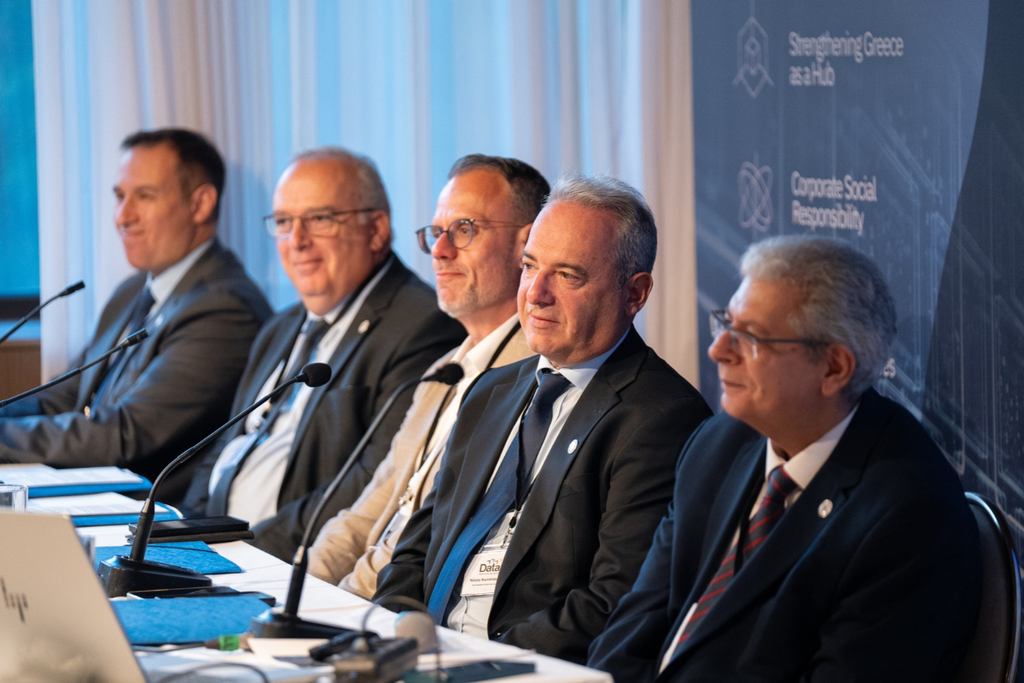
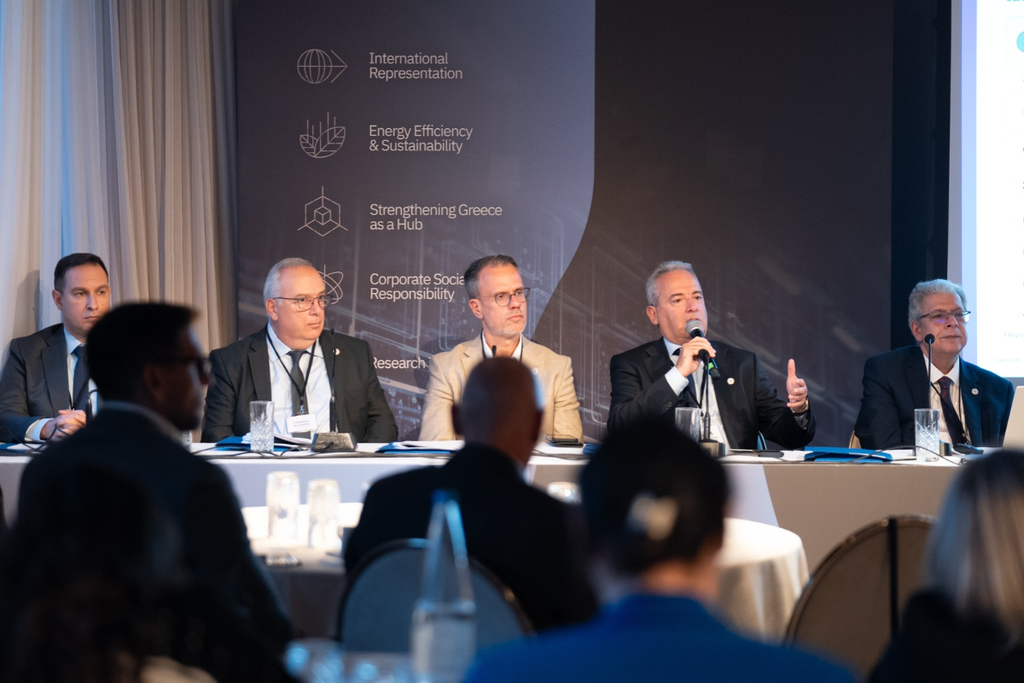
The Greek Data Center Association (GRDCA) presented its views on the future of data centers in Greece at its first Press Conference, held on Wednesday, 11 November, at Aigli Zappeiou. The Press Conference was attended by the Association’s President, Alexandros Bechrakis (Managing Director Greece, Digital Realty), Vice President, Nikos Konstantinidis (Country Director Greece, Data4), Board Secretary, George Dritsanos (Vice President Secure Power & Data Centers Business CEE, Schneider Electric), Treasurer, Nikos Madias (Technical Director Greece, Sparkle) and Tilemachos Moraitis (Government Affairs Director Greece, Cyprus, Malta & Adriatics, Microsoft), representing Microsoft on the GRDCA Board. GRDCA currently has 70 member companies and 6 independent advisors, having grown from just 10 members in approximately 18 months.
Critical Infrastructure
The Press Conference highlighted the pivotal role data centers play in the functioning of today’s economy and society. Payment systems and banking services, healthcare systems, public digital services, telecommunications and logistics all rely heavily on the reliable and uninterrupted operation of digital infrastructure. Their importance is also recognised in European legislation, particularly through the NIS2 and CER Directives.
The Digital Gap and Market Opportunity
As highlighted during the Press Conference, Greece still lags behind other markets in terms of data center infrastructure. This gap presents a significant challenge, but also creates considerable opportunities for growth.
Data centers currently account for approximately 0.1% of Greece’s total electricity consumption, compared to a global average of around 1.5% (IEA). The figure rises to 3–5% in countries such as Germany, the Netherlands and the United States. Similarly, electricity consumption by data centers per capita in Greece is around eight times lower than the global average. These figures highlight that a considerable share of the demand for digital services in Greece is still being served by data centers located abroad. Meanwhile, the International Energy Agency (IEA) estimates that global electricity consumption by data centers will more than double, increasing from 415 TWh in 2024 to 945 TWh by 2030. As demand continues to grow, countries that invest in the necessary infrastructure in time will be better positioned to attract new business and investment.
The Greek market is already showing tangible progress. Around 40–60 MW of data center capacity is currently under development or in advanced stages of construction, with total investments of approximately €1 billion in operational and under-construction projects. Despite this strong momentum, Greece’s ability to capitalize on the growing investment interest will largely depend on the availability of sufficient electricity capacity and a stable, predictable regulatory framework. GRDCA advocates for a thorough assessment of the maturity of grid connection applications, ensuring that genuine investment projects are distinguished from speculative or insufficiently developed proposals, without creating unnecessary obstacles for projects that are ready to proceed. The total investment interest in the Greek market could reach up to €10 billion, provided that the necessary conditions are in place to support the implementation of viable, mature investments.
Closing this digital infrastructure gap is not merely an investment opportunity; it is a prerequisite for Greece to strengthen its position as a regional digital hub for cloud, AI and critical digital services.
Position Papers
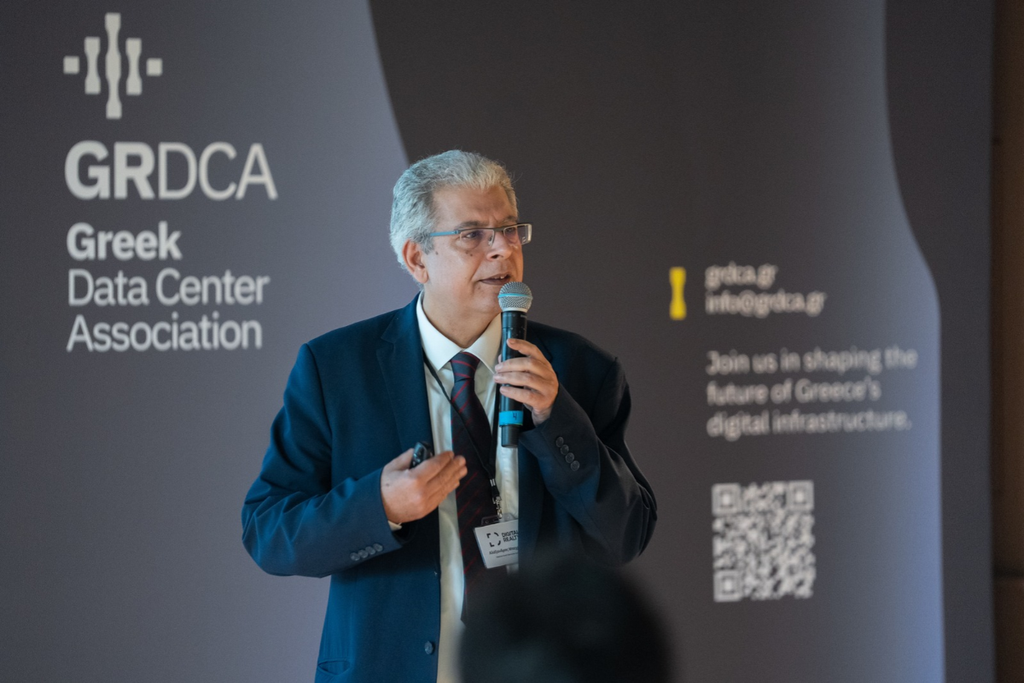
During the Press Conference, GRDCA presented its three position papers, covering energy, water and noise. These papers address frequently asked questions and provide clear, evidence-based information on each topic. Data centers account for just 0.1% of Greece’s annual electricity consumption, equivalent to approximately 65 GWh in 2024, with an IT load of close to 20 MW. Even if the sector’s IT load reaches the projected 200–250 MW, its share of national electricity consumption could approach 1%, depending on future development and usage. The vast majority of data centers in Greece use air-cooling systems and closed-loop cooling circuits, resulting in almost no water consumption during normal operations. : In many cases, the noise generated by a modern data center at the site boundary is practically indistinguishable from the background noise of a typical urban or industrial area. This is no coincidence, but the result of careful planning and the use of high-quality equipment designed to meet strict technical standards. It is worth noting that modern variable-speed fans can reduce noise levels by up to 15 dB(A) compared to older technologies. As for backup generators, EUDCA reference figures indicate an average of 20–40 operating hours per year for testing and maintenance purposes.
Industry Responsibility
During the Press Conference, it was highlighted that GRDCA, a member of the EUDCA (European Data Centre Association) since 2026, is actively involved in the Climate Neutral Data Centre Pact. The industry’s commitments include measuring and reporting key performance indicators, such as PUE and WUE, as well as other environmental KPIs. They also cover long-term planning, engagement with local communities, skills development and continuous improvement. The underlying principle is that the approval to develop a data center comes with a responsibility to deliver results, operate transparently and build trust.
GRDCA President Alexandros Bechrakis stressed that data center investments typically take 10 to 15 years to pay back and have an operational lifespan of 30 to 50 years, while construction can take between 3 and 5 years. For this reason, he emphasised the need for a stable and predictable regulatory environment: The rules cannot change two or three times while a project is still under construction.
About GRDCA
The Greek Data Center Association (GRDCA) is a non-profit organisation representing the collective economic, legal, commercial and technical interests of companies that operate, build or provide data center infrastructure in Greece. Its mission is to accelerate the growth of Greece’s data center industry, strengthen energy efficiency and establish the country as a key regional digital hub. GRDCA also works to foster a competitive environment for new data center investments, promote more streamlined procedures for the development and operation of infrastructure, and enhance its sustainability and performance. Furthermore, the Association promotes corporate social responsibility across the sector, advocates high occupational health and safety standards, and supports skills development, contributing to the overall strengthening of Greece’s digital ecosystem.
For more information: www.grdca.gr
#PressRelease #GRDCA #GreekDataCenterAssociation #EnergiaTec
Contact for members of the Press (GRDCA): marketing@grdca.gr
PR Agency for GRDCA: Social Handlers, Popi Gkikouria, Phone: +30 695 630 1050, popi@socialhandlers.com